OMS, Reconciliation & Operations Guides
Expert content on order management systems, payment reconciliation, warehouse management, and multichannel inventory for Indian marketplace sellers.
Topic Clusters — Build Topical Authority
Browse by strategic topic to find guides on OMS, reconciliation, WMS, and multichannel inventory.
All Articles
74 articles Feature Guide
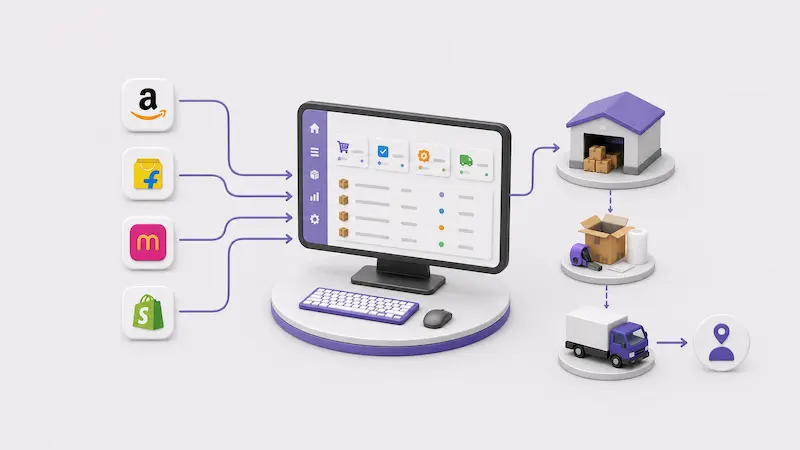
Manage Multi-Channel Orders from One Dashboard
Sellers running Amazon, Flipkart, Meesho, and Shopify side by side typically lose 3-5% of potential revenue to overselling and missed orders caused by switching between four separate dashboards — here's how a unified view fixes that.
Seller ProblemsWhy Sellers Lose Orders During Sale Events
Understand the operational gaps that cause lost orders during peak sale periods and how to prevent them.
Seller ProblemsHow to Handle 1000+ Orders Per Day
Scale your order processing capacity through automation and smart workflows instead of adding headcount.
Seller ProblemsCommon Order Delay Causes & Solutions
Order delays rarely come from a single big failure — they usually stack from three or four small, preventable gaps that compound into a missed delivery window.
Seller ProblemsMarketplace Inventory Mismatch
If your system says 20 units are in stock but you can only find 14 on the shelf, the gap isn't a counting error — it's usually one of three specific process failures.
Seller ProblemsThe Hidden Cost of Manual Order Processing
Manual order processing doesn't show up as a line item on your P&L — but it costs real money through three specific, measurable leaks most sellers never calculate.
Seller ProblemsHow to Reduce Order Errors by 90%
Most fulfillment errors trace back to just two points in the process — picking the wrong item and shipping to the wrong address — and both are largely preventable with the right checks.
Seller ProblemsWhy Growing Sellers Struggle With Operations
Operational strain doesn't scale linearly with order volume — it scales with complexity, which is why a seller doubling SKU count often struggles more than one doubling order volume alone.
Seller ProblemsOperational Bottlenecks That Kill eCommerce Growth
A single operational bottleneck can cap growth even when demand, product, and marketing are all working — because a business can only fulfill as fast as its slowest process allows.
MarketplacesAmazon Inventory Management Guide
Amazon suppresses listings that go out of stock more than a few times in a short window — here's how inventory management actually protects your Buy Box eligibility, not just your stock count.
MarketplacesFlipkart Order Management Best Practices
Flipkart's seller rating algorithm weighs order defect rate and late shipment rate more heavily than most sellers realize — here's what actually protects both.
MarketplacesMeesho Seller Operations Guide
Meesho had over 700,000 active sellers by late 2025 — here's how order, payment, and return operations actually work once you're past your first few dozen sales.
MarketplacesMulti-Channel Marketplace Management Guide
Sellers on 3+ marketplaces typically spend 8-10 hours a week just switching between seller panels — before they've processed a single order. Here's what actually needs consolidating, and what doesn't.
MarketplacesMarketplace Inventory Sync Explained
Real-time inventory sync doesn't mean "updates every hour" — it means every marketplace reflects a sale within seconds, and the difference matters more than most sellers realize.
MarketplacesCommon Marketplace Selling Mistakes
Most new marketplace sellers lose money in their first 90 days not from bad products, but from three specific operational mistakes that compound quietly until they show up as a cash flow problem.
MarketplacesMarketplace Operations Best Practices
Top-performing marketplace sellers don't work harder than everyone else — they've automated the three specific tasks that eat the most manual hours: order confirmation, label generation, and stock sync.
MarketplacesMulti-Marketplace Selling Guide
Selling on 3+ marketplaces multiplies your reach — and multiplies your operational risk in three specific ways most sellers don't anticipate until they've already hit them.
Shopify & D2CShopify Inventory Management Explained
Shopify's native inventory tracking works well for a single-channel store — the problems start the moment you also sell on Amazon, Flipkart, or in a physical location alongside it.
Shopify & D2CHow D2C Brands Scale Operations Efficiently
D2C brands rarely fail from lack of demand — most operational breakdowns happen specifically between 500 and 2,000 monthly orders, when manual processes that worked at low volume stop working overnight.
Shopify & D2COMS for Shopify Stores: Benefits and Features
Shopify's own admin panel handles single-channel order management well — the case for a dedicated OMS starts the moment you add a second sales channel or your order volume outgrows manual fulfillment tracking.
Shopify & D2CWebsite vs Marketplace Order Management
Website orders and marketplace orders look similar on the surface but follow different rules underneath — treating them identically is where most D2C brands' operational problems start.
Shopify & D2CD2C Operations Management Guide
D2C brands that build operational discipline before scaling avoid the most common failure mode: growing revenue faster than the systems needed to fulfill it.
Shopify & D2COmnichannel Selling vs Multichannel Selling
Multichannel means selling on several platforms; omnichannel means those platforms share one unified view of inventory and customer data — the difference determines whether adding a new channel helps or hurts your operations.
Shopify & D2CD2C Fulfillment Automation Guide
Fast-growing D2C brands don't hire their way out of fulfillment bottlenecks — they automate the repetitive decisions first and hire for judgment-based work second.
Shopify & D2CCommon D2C Scaling Challenges
D2C brands rarely fail from a single big mistake while scaling — they usually stall from three specific, predictable challenges that hit almost every brand at a similar growth stage.
WarehouseWhat Is Warehouse Management?
A comprehensive introduction to warehouse management for ecommerce businesses.
WarehouseOMS vs WMS: Key Differences
Understand how Order Management and Warehouse Management systems complement each other.
WarehouseHow Warehouse Automation Improves Accuracy
Explore automation technologies that reduce errors and increase warehouse efficiency.
WarehouseOrder Fulfillment Workflow Explained
Step-by-step guide through the complete order fulfillment process.
WarehousePick, Pack & Ship Process Guide
Master the three core warehouse operations that power every ecommerce delivery.
WarehouseWarehouse KPIs Every Seller Should Track
The essential metrics that reveal your warehouse performance and efficiency.
WarehouseFulfillment Challenges in eCommerce
Common fulfillment obstacles and proven strategies to overcome them.
WarehouseWarehouse Management Best Practices
Implement smart strategies that transform your warehouse into a competitive advantage.
InventoryInventory Turnover Ratio Explained
Learn how to calculate and optimize your inventory turnover for better cash flow.
InventorySafety Stock: What It Is and Why It Matters
Master the concept of safety stock and protect your business against demand uncertainty.
InventoryABC Inventory Analysis Guide
Classify your inventory using the ABC method to focus efforts where they matter most.
InventoryeCommerce Inventory Forecasting Guide
Use data-driven forecasting to maintain optimal stock levels across all channels.
InventorySale Season Inventory Planning
Strategies for preparing your inventory before major sale events and festive seasons.
InventoryOverstocking vs Understocking
Find the sweet spot between too much and too little inventory for your business.
InventoryInventory Audit Best Practices
Implement systematic inventory audits that keep your stock records accurate.
InventoryReal-Time Inventory Tracking Guide
Discover how real-time inventory visibility transforms your operational efficiency.
OMSAdvanced OMS Features Guide
The essential OMS features that power scalable ecommerce operations.
OMSAI in Order Management Systems
How artificial intelligence is revolutionizing order management and fulfillment.
OMSHow OMS Improves Customer Experience
The direct connection between order management excellence and customer satisfaction.
OMSOMS Integration with ERP Systems
Best practices for connecting your OMS with enterprise resource planning systems.
OMSOMS Integration with Shipping Aggregators
Streamline your shipping workflow by connecting OMS with shipping platforms.
OMSOMS Analytics and Reporting
Leverage OMS data to make informed operational decisions and drive growth.
OMSCloud-Based OMS vs Traditional OMS
Compare modern cloud solutions with legacy systems to make the right choice.
OMSChoosing the Right OMS for Your Business
A practical framework for evaluating and selecting the best OMS for your needs.
ReturnsHow to Reduce Product Returns
Proven strategies to minimize return rates while maintaining customer satisfaction.
ReturnsReverse Logistics Explained
Understanding the complete reverse logistics process for ecommerce businesses.
ReturnsWhy Return Management Matters
The business impact of effective return management on profitability and loyalty.
ReturnsRefund Management Guide
Streamline your refund process to improve cash flow and customer experience.
ReturnsCommon Return Fraud Scenarios
Identify and prevent return fraud patterns that eat into your profit margins.
ReturnseCommerce Return Analytics Guide
Use return data analytics to uncover insights and drive operational improvements.
ReturnsOMS Return Management Guide
Modern OMS features that automate and streamline the entire returns process.
ReturnsReturn Rate Reduction Guide
A comprehensive toolkit of strategies to systematically reduce your return rates.
GrowthScale eCommerce Orders Efficiently
The operational roadmap for scaling order volume without losing control.
GrowtheCommerce Operations Team Guide
Structure and hire the right operations team as your ecommerce business grows.
GrowthEssential eCommerce Business KPIs
The essential KPIs that tell you if your operations are healthy and scalable.
GrowthAutomation for Higher Profit Margins
Quantify the financial impact of operational automation on your bottom line.
GrowthGrowth Strategies for Indian eCommerce Sellers
Tailored growth strategies for sellers operating in the Indian ecommerce market.
GrowthScaling Without Operational Chaos
Grow your business while maintaining operational order and team sanity.
GrowthOperational Efficiency Guide
A systematic framework for measuring and improving operational efficiency.
GrowthHow Successful Brands Scale
Case study insights from brands that scaled successfully without breaking operations.
ComparisonsOMS vs ERP: Complete Comparison Guide
An in-depth feature-by-feature comparison to help you choose the right system for your business operations.
ComparisonsOMS vs WMS Comparison
Understand how OMS and WMS differ, complement each other, and work together in modern ecommerce.
ComparisonsOMS vs Inventory Management Software
Compare OMS capabilities with standalone inventory tools to make an informed technology decision.
ComparisonsOMS vs Excel Comparison
Why growing businesses outgrow spreadsheets and when to make the switch to a proper OMS.
ReconciliationAmazon Payment Reconciliation Guide
Step-by-step guide to matching Amazon settlements, fees, and payouts with your orders using automated payment reconciliation.
ReconciliationFlipkart Settlement & Reconciliation Explained
Understand Flipkart payment cycles, commission deductions, and how to automate settlement reconciliation with EliteOMS.
ReconciliationMeesho Payout Reconciliation Guide
How to reconcile Meesho payouts, track unsettled orders, and recover revenue lost to fee discrepancies.
ReconciliationReturn Reconciliation vs Payment Reconciliation
Learn the difference between return reconciliation and payment reconciliation — and why ecommerce sellers need both.
ReconciliationGST Reconciliation for Marketplace Sellers
A practical guide to GST reconciliation for Amazon, Flipkart, and multichannel sellers — TCS, invoices, and compliance.
Ready to Simplify Your Operations?
Manage orders, inventory, warehouses, and returns from one platform.